
Quantum Security 101

Understand Quantum Risk to Enterprise Encryption

Quantum computers will eventually break the public-key cryptography that protects enterprise data in transit and at rest. Understand what that means, why the clock has already started, and what to do now.
The Threat

Quantum breaks two things at once: confidentiality and trust

The same break in public-key cryptography undermines both the confidentiality of stored data and the integrity of digital signatures.

One exposes what you kept secret. The other lets an attacker forge what others trust.

Harvest Now, Decrypt Later

Adversaries intercept and store encrypted data today, waiting to decrypt it when a sufficiently powerful quantum computer arrives.

A stolen encrypted file can be read the moment that computer succeeds. The exposure is retroactive and cannot be undone after the fact.

Trust Now, Forge Later

The public-key cryptography behind digital signatures and certificates can also be broken by a quantum computer.

An attacker could forge signatures at internet scale: impersonating trusted vendors, signing malicious firmware, issuing fraudulent certificates, and backdating transactions.

One layer down, the mechanism is Shor’s algorithm (1994), which breaks both RSA and elliptic-curve cryptography. Elliptic-curve signatures, used across PKI and code-signing, are expected to fall sooner than RSA encryption because they require far fewer quantum operations.

Q-Day Timeline

The timeline to a code-breaking quantum computer is compressing

Q-Day is the point at which a cryptographically relevant quantum computer can break RSA and elliptic-curve cryptography, the mathematics underpinning almost all internet security today.

The Global Risk Institute’s Quantum Threat Timeline Report, which surveys more than 30 global experts, places the most likely window in the 2030s, with conservative forecasts reaching into the 2040s.

The New Benchmark

Google has set a 2029 deadline to complete its own post-quantum migration, and called on the rest of the industry to match it.

Announced by Google’s security engineering leadership in March 2026, a full year ahead of the NIST deprecation target of 2035.

Planning Horizons

Aggressive (Google)
2029
Regulatory (NIST / NSA)
2030–2035
Conservative
2040+

The Math

How exposed is your data?

In 2015, cryptographer Michele Mosca formalized quantum risk into a single inequality that every board should understand.

Your total protection time (A + B)

ATime to assess exposure and migrate to quantum-resistant systems
BTime your data must stay confidential
Exposure window

Threat arrival time (C)

CTime before a quantum computer capable of breaking today’s encryption exists
Q-Day estimates are compressing faster than expected.

If A + B > C, your organization is already vulnerable.

Most enterprises need years to migrate cryptography completely, and large, complex estates can need well over a decade. If your data must stay confidential beyond 2030, the time to start is now.

Typical migration timelines

3–5 yr

Small enterprise

8–12 yr

Mid-market

12 yr+

Large or complex estate

Regulatory Landscape

Regulators have already set the deadlines

Quantum-safe migration is a compliance obligation, not only a security upgrade. Standards bodies and regulators across major markets have finalized algorithms or set dated migration targets.

  • US

    United States

    • NIST FIPS 203, 204, 205 finalized Aug 2024
    • NSA CNSA 2.0: NSS transition by 2035
    • First procurement cutoff: Jan 1, 2027
    • NSM-10 policy ceiling: 2035
  • EU

    European Union

    • Coordinated Roadmap (June 2025)
    • National strategies by end 2026
    • High-risk systems safe by end 2030
    • DORA cryptographic resilience expectations
  • UK

    United Kingdom

    • NCSC migration roadmap
    • Discovery by 2028
    • High-priority migration by 2031
    • Full transition by 2035
  • CA

    Canada

    • Government PQC roadmap (June 2025)
    • Initial dept. plans by April 2026
    • High-risk systems by end 2031
    • Full transition by 2035
  • AU

    Australia

    • ASD guidance issued
    • Traditional asymmetric crypto not permitted beyond 2030
    • Transition plans by end 2026
  • SG

    Singapore

    • MAS Circular MAS/TCRS/2024/01
    • Financial sector cryptographic resilience
    • CSA quantum guidance in development
  • JP

    Japan

    • CRYPTREC migration framework
    • National government coordination
    • Aligned to NIST standards
  • KR

    South Korea

    • KISA coordinated framework
    • National PQC research program
    • Aligned to NIST standards

Industry Exposure

Every regulated sector is on the clock

Exposure is not uniform. Sectors that combine long data-confidentiality lifetimes with heavy regulation are first in line, and for many of them quantum readiness is already an audited or contractual requirement.

  1. 01

    Financial Services

    Transaction and customer records carry decade-plus retention. DORA, PCI DSS 4.0, and the EU PQC Roadmap will surface in upcoming audit cycles.

  2. 02

    Government & Defense

    Classified communications have the longest secrecy requirements of any sector. CNSA 2.0 mandates quantum-safe acquisitions from January 2027.

  3. 03

    Healthcare, Pharma, Genomics

    Patient records carry 7 to 30 year retention. Genomic data is permanently sensitive and cannot be re-encrypted once exposed.

  4. 04

    Critical Infrastructure & OT

    Grids, water, satellites, and telecom rely on industrial control systems with multi-decade replacement cycles. The EU PQC Roadmap targets migration by 2030.

  5. 05

    Hardware, Networking, Security

    Devices shipped today will operate for 10 to 20 years. PQC-capable firmware will be required, and non-upgradeable hardware will become unsellable to regulated buyers.

  6. 06

    Blockchain Infrastructure

    Oracle attestations, L2 fraud proofs, cross-chain messages, and smart-contract signatures use ECC. Institutional partners will inherit PQC deadlines.

  7. 07

    Transportation & Robotics

    Transport hardware has the longest lifecycles of any commercial sector. Vehicles deployed in 2026 without quantum resistance remain vulnerable for full service life.

  8. 08

    Digital Identity & Credentials

    Identity data persists indefinitely. Credentials issued today on ECC-signed systems remain permanently vulnerable to retroactive forgery.

Recommended Actions

Five concrete actions to take now

None of these require waiting for a quantum computer to exist. Each is a planning step you can start this quarter.

  1. 01

    Inventory your cryptography

    Map where RSA and elliptic-curve algorithms live across TLS, PKI, HSMs, certificates, code-signing, and third-party services.

  2. 02

    Prioritize by data lifetime

    Rank systems by how long their data must stay confidential, measured against the harvest-now window.

  3. 03

    Require crypto-agility

    Make the ability to swap algorithms a procurement and architecture standard for new systems now.

  4. 04

    Engage your vendors

    Confirm the post-quantum migration plans of your cloud, VPN, and software providers, as Google has urged the industry to do.

  5. 05

    Assess your exposure

    Commission an independent, human-led snapshot that tells the board where to act first.

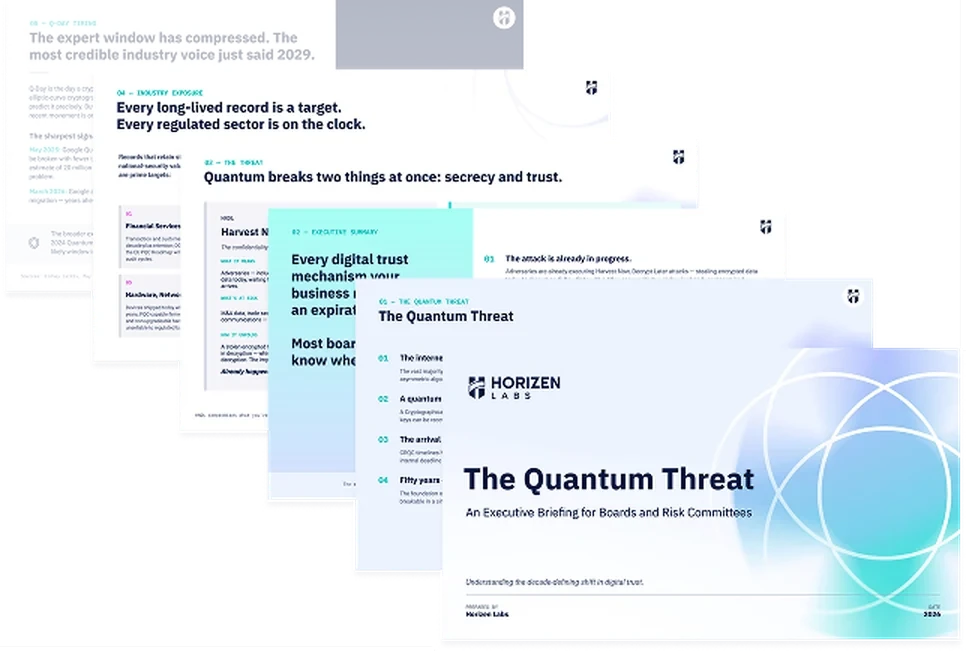
The Quantum Threat, an executive briefing deck for boards and risk committees

Board Meeting Material

The executive briefing for boards and risk committees

The briefing explains the threat without technical overhead, anchors the timeline to current expert data and regulatory mandates, and gives the board five concrete actions they can approve in a single meeting.

It is a decision-support tool for the room where quantum risk either gets funded or ignored.

What to do now

Assess your cryptographic exposure

Start with a quantum threat assessment. You cannot migrate what you cannot see.

Horizen Labs runs a human-led cryptographic exposure assessment that requires no software deployment and makes no changes to live systems, producing a board-ready exposure snapshot.

Talk to the Quantum Security team

Common questions

Quantum security, answered

What is “harvest now, decrypt later”?

Harvest now, decrypt later (HNDL) is an attack in which adversaries store encrypted data today and decrypt it once a capable quantum computer exists. It makes quantum risk present-tense: any data that must stay confidential for years is already exposed.

Is quantum a real threat today, or years away?

Both. A code-breaking quantum computer does not exist yet, with most expert forecasts pointing to the 2030s. But because of harvest-now-decrypt-later, and because migration takes years, the risk and the work are present-day.

Which regulations require quantum-safe cryptography?

Quantum-safe migration is already a compliance obligation in several markets. NIST finalized its first quantum-resistant standards (FIPS 203, 204, 205) in August 2024, the EU’s DORA requires cryptographic resilience, and the US NSA’s CNSA 2.0 sets dated targets through the 2030s.

How long does migration take?

Typically three to five years for a small enterprise, eight to twelve for mid-market, and well over a decade for a large or complex estate. Against regulatory deadlines and the harvest-now window, most programs are already behind.

Quantum-resistant vs post-quantum cryptography: what’s the difference?

The same thing. Post-quantum cryptography (PQC) is the research and standards term; quantum-resistant is the plainer, equivalent term Horizen Labs uses. Both describe algorithms designed to withstand a quantum computer.

Where should our organization start?

Start by understanding your exposure before planning a migration. A cryptographic exposure assessment shows where vulnerable algorithms live and tells your board where to act first.

See all FAQs